NABH (National Accreditation Board for Hospitals & Healthcare Providers) accreditation is the gold standard for healthcare quality in India. Over 4,200 hospitals in India are now NABH-accredited, and accredited hospitals report a 60% reduction in patient complaints. This comprehensive guide covers the complete process, all 10 chapters, costs (₹3-25 Lakhs), and a 12-month timeline to achieve NABH accreditation.
What is NABH Accreditation?
NABH is a constituent board of the Quality Council of India (QCI), established to set benchmarks for healthcare quality. NABH accreditation signifies that a hospital meets international standards of healthcare delivery.
92% of NABH-accredited hospitals report higher patient trust scores within the first year of accreditation.
Benefits of NABH Accreditation:
- Higher reimbursement rates from insurance companies (10-15% more). NABH Entry Level hospitals get 10% extra on PMJAY claims
- Government tender eligibility — mandatory for CGHS empanelment
- Increased patient trust and footfall (up to 30% increase reported)
- Improved operational efficiency through standardized processes
- Reduced medical errors and litigation risk by up to 40%
Types of NABH Accreditation
NABH offers different programs based on facility type and size. For a detailed comparison, read our guide on NABH Entry Level vs Full Accreditation.
- Full Accreditation: For hospitals with 50+ beds — covers all 10 NABH chapters under the 6th edition
- Entry Level: Stepping stone for smaller hospitals — covers 5 key chapters
- SHCO (Small Healthcare Organizations): For clinics and nursing homes under 50 beds
- Pre-Accreditation Entry Level (PEL): First step for first-time applicants
How Many Chapters Are in NABH? All 10 Chapters Explained
NABH evaluates hospitals across 10 chapters containing 651+ objective elements. Here's each chapter with its focus area:
- AAC: Access, Assessment, and Continuity of Care — covers OPD queue management and patient flow
- COP: Care of Patients — clinical protocols and treatment standards
- MOM: Management of Medication — drug safety, formulary management. Requires pharmacy management software
- PRE: Patient Rights and Education — consent management, patient grievances
- HIC: Hospital Infection Control — hand hygiene, waste management, antimicrobial stewardship
- CQI: Continuous Quality Improvement — quality indicators, clinical audits
- ROM: Responsibilities of Management — leadership, strategic planning
- FMS: Facility Management and Safety — fire safety, OT management, equipment maintenance
- HRM: Human Resource Management — staff credentialing, training records
- IMS: Information Management System — requires digital HMS with complete modules
For the complete audit preparation checklist, see our NABH Audit Checklist: 200+ Documents Guide.
Step-by-Step NABH Accreditation Process (12-Month Timeline)
The average NABH accreditation takes 10-12 months from gap analysis to final assessment. Here's the detailed timeline:
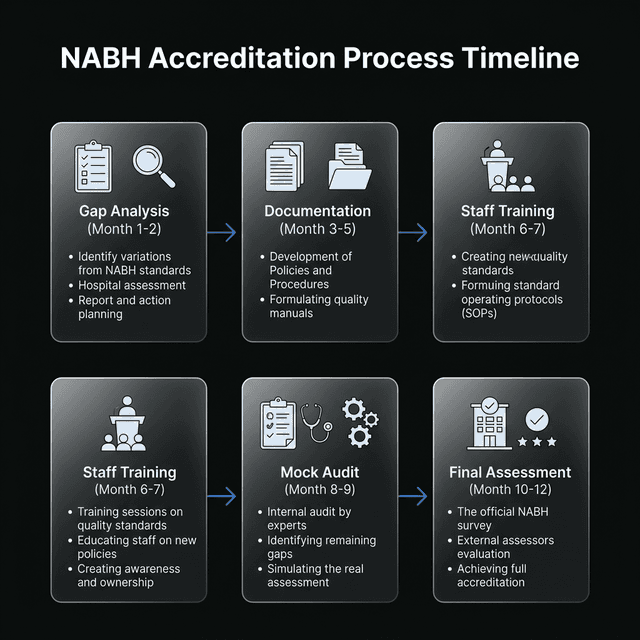
Phase 1: Gap Analysis (Month 1-2)
- Conduct internal assessment against NABH standards
- Identify gaps in documentation and processes
- Create action plan with timelines
- Assign responsibilities to department heads
Phase 2: Documentation (Month 2-6)
- Develop SOPs for all clinical and administrative processes
- Create policy manuals for each department
- Implement documentation checklists
- Train staff on documentation requirements
Phase 3: Implementation (Month 4-9)
- Roll out new processes across departments
- Conduct internal audits
- Address non-conformities
- Build evidence of compliance
Phase 4: Pre-Assessment (Month 9-10)
- Optional mock assessment
- Identify remaining gaps
- Final corrections
Phase 5: Final Assessment (Month 10-12)
- NABH assessors visit for 3-4 days
- Document review and process verification
- Staff interviews and tracer methodology
- Accreditation decision
Critical Documentation Requirements (200+ Documents)
NABH requires 200+ documents across all 10 chapters. Hospitals that use digital HMS software reduce documentation preparation time by 60%. Key documents include:
- Quality Manual and Quality Policy
- Department SOPs (all clinical and support areas)
- Consent forms (multiple types — general, surgical, anesthesia, blood transfusion)
- Assessment forms (initial, ongoing, discharge, transfer)
- Infection control logs and audit trail records
- Equipment maintenance records (preventive and corrective)
- Training records with competency assessments
- Incident reports, root cause analysis, and CAPA
- Quality indicators dashboard — requires MIS reporting module
Common Reasons for NABH Failure
- Incomplete documentation: Missing SOPs, unsigned forms
- Staff unaware: Staff can't explain processes during interviews
- Inconsistent practices: Documentation says one thing, practice is different
- Infection control gaps: Hand hygiene compliance, waste segregation
- Fire safety issues: Non-functional equipment, blocked exits
How Hospital Management Software Helps with NABH Compliance
Hospitals using modern HMS software complete NABH accreditation 40% faster than those relying on manual processes. Here's how software automates compliance:
- Automatic documentation: EMR ensures complete patient records across all 15 HMS modules
- Consent tracking: Digital consents with timestamps and e-signatures
- Medication management: Drug interaction alerts, unit dose tracking via integrated pharmacy module
- Audit trails: Complete history of all actions — critical for Chapter IMS
- Quality indicators: Automated calculation and dashboards for CQI chapter
- Incident reporting: Digital incident capture, RCA, and CAPA tracking
- ABDM integration: ABHA ID creation and health record sharing — increasingly important for NABH 6th edition
NABH Accreditation Costs
Typical costs for a 100-bed hospital:
- NABH fees: ₹3-5 lakhs
- Consultant fees: ₹5-15 lakhs
- Infrastructure upgrades: Variable
- Training: ₹1-2 lakhs
- Total: ₹10-25 lakhs approximately
Maintaining NABH Accreditation
NABH accreditation is valid for 3 years. Renewal requires re-assessment and continued compliance. To maintain your accreditation:
- Continuous quality monitoring with monthly indicator reviews
- Annual surveillance (self-assessment) — submit to NABH portal
- Keep documentation updated in your HMS software
- Address any non-conformities within 90 days
- Stay current with NABH 6th edition changes
Related Articles
- NABH Entry Level vs Full Accreditation: Which Should You Choose?
- NABH Entry Level Incentive 2026: Fees & Process Guide
- NABH 6th Edition Standards: 10 Key Changes
- NABH Audit Checklist: 200+ Documents Your Hospital Needs
- 15 Standard Modules in Hospital Management System
NABH-Ready Hospital Software
Adrine comes with built-in NABH compliance features — auto-documentation, consent tracking, quality indicators, and audit-ready reports. Over 92% of our hospital clients achieve NABH accreditation on their first attempt.
See NABH Features →