"What is the incentive decided for the NABH entry level hospitals?" — this is one of the most searched questions by hospital administrators in India. The answer: 10% extra on PMJAY (Ayushman Bharat) package rates. But there's much more to understand about fees, eligibility, and the application process. This guide covers everything.
NABH Entry Level Incentive: The Bottom Line
Here's the incentive structure at a glance:
NABH Entry Level hospitals get 10% extra on PMJAY claims.
Entry Level accreditation costs 50% less than Full accreditation.
| Accreditation Level | PMJAY Incentive | Fees | Timeline | Validity |
|---|---|---|---|---|
| Entry Level | 10% extra | ₹1-3 Lakhs | 3-6 months | 2 years |
| Full Accreditation | 15% extra | ₹5-10 Lakhs | 12-18 months | 3 years |
| No NABH | Base rate only | ₹0 | — | — |
Example: If a cataract surgery package under PMJAY is ₹30,000:
- Non-NABH hospital gets: ₹30,000
- NABH Entry Level hospital gets: ₹33,000 (10% extra)
- Full NABH hospital gets: ₹34,500 (15% extra)
Over a year with 500 PMJAY cases, that's an extra ₹15-22.5 lakhs in revenue — far exceeding the certification cost.
What is NABH Entry Level Certification?
NABH Entry Level is a simplified version of NABH accreditation designed for smaller hospitals that want to demonstrate quality commitment without the complexity of full accreditation. It was introduced to make quality improvement accessible to hospitals across India, especially in Tier 2 and Tier 3 cities.
Key facts about Entry Level:
- Covers approximately 50 standards (vs 600+ for full accreditation)
- Focuses on patient safety and infection control
- Available for hospitals of all sizes (even 10-bed setups)
- Second edition standards effective from January 1, 2026
- Assessment can be completed in 1-2 days
NABH Entry Level Fees Breakdown
| Hospital Size | Application Fee | Assessment Fee | Total (Approx) |
|---|---|---|---|
| Up to 50 beds | ₹25,000 | ₹75,000 | ₹1,00,000 |
| 51-100 beds | ₹35,000 | ₹1,15,000 | ₹1,50,000 |
| 101-200 beds | ₹50,000 | ₹1,50,000 | ₹2,00,000 |
| 200+ beds | ₹75,000 | ₹2,25,000 | ₹3,00,000 |
Note: Additional costs include consultant fees (₹50K-2L), staff training (₹20-50K), and documentation preparation. Using HMS software with built-in NABH compliance (like Adrine) significantly reduces these costs.
Entry Level vs Full Accreditation: Detailed Comparison
| Parameter | Entry Level | Full Accreditation |
|---|---|---|
| Standards | ~50 objective elements | 600+ objective elements |
| Chapters | Simplified (key areas) | All 10 chapters |
| Focus | Patient safety, infection control | Comprehensive quality |
| Assessment Duration | 1-2 days | 3-5 days |
| Preparation Time | 3-6 months | 12-18 months |
| Total Cost | ₹1-3 Lakhs | ₹5-10 Lakhs |
| PMJAY Incentive | 10% | 15% |
| Validity | 2 years | 3 years |
| Insurance Recognition | Growing | Widely recognized |
| Medical Tourism | Limited benefit | Strong advantage |
Documents Required for NABH Entry Level
- Hospital registration certificate
- Clinical establishment license
- Biomedical waste management authorization
- Fire safety certificate
- List of medical equipment
- Staff credentials and qualifications
- Standard Operating Procedures (SOPs)
- Infection control protocols
- Patient feedback system documentation
- Quality improvement plans
Step-by-Step Application Process
Step 1: Self-Assessment
Review the NABH Entry Level standards document and assess your hospital's current compliance level. Identify gaps that need to be addressed.
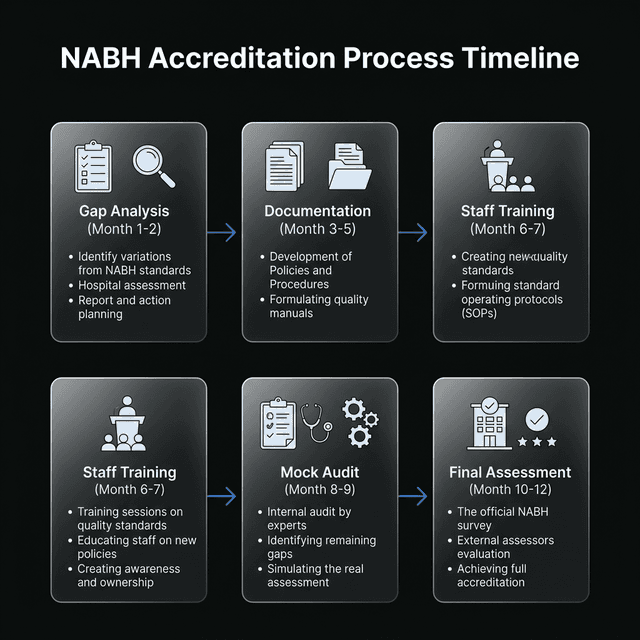
Step 2: Gap Analysis & Preparation
Work with a NABH consultant or use quality management software to create SOPs, policies, and documentation. This typically takes 2-4 months.
Step 3: Online Application
Submit your application on the NABH portal (nabh.co) with required documents and fees.
Step 4: Document Review
NABH reviews your submitted documentation. They may request additional information or clarifications.
Step 5: On-Site Assessment
NABH assessors visit your hospital for 1-2 days. They evaluate compliance against entry level standards through observations, interviews, and record reviews.
Step 6: Certification Decision
Based on the assessment report, NABH grants certification (if compliant) or provides a non-conformity report with areas for improvement.
How HMS Software Helps with NABH Entry Level
Modern HMS software like Adrine includes built-in NABH compliance features that automate much of the preparation:
- Auto-generated SOPs and policies that meet NABH requirements
- Quality indicator tracking with dashboards
- Incident reporting system built into the workflow
- Patient safety alerts for medication errors, falls, etc.
- Audit-ready reports that assessors can review
- Training management for staff compliance records
Frequently Asked Questions
Is NABH entry level mandatory?
No, NABH accreditation (including entry level) is voluntary. However, hospitals empanelled under PMJAY/Ayushman Bharat strongly benefit from entry level certification due to the 10% incentive.
Can a hospital directly apply for full NABH?
Yes. Entry level is not a prerequisite for full accreditation. However, most small hospitals start with entry level as it's simpler and cheaper, then progress to full accreditation.
What happens after 2 years?
Entry level certification must be renewed every 2 years. Many hospitals use the initial 2-year period to prepare for full accreditation, which has a 3-year validity.
Related Articles
- NABH 6th Edition Standards 2026: 10 Key Changes Every Hospital Must Know
- NABH Audit Checklist 2026: 200+ Documents Your Hospital Needs
- 15 Standard Modules in Hospital Management System
- Hospital Billing Software with GST 2026
Automate Your NABH Preparation
Adrine includes built-in NABH compliance — SOPs, quality indicators, and audit-ready reports. Save months of preparation time.
Book Free Demo