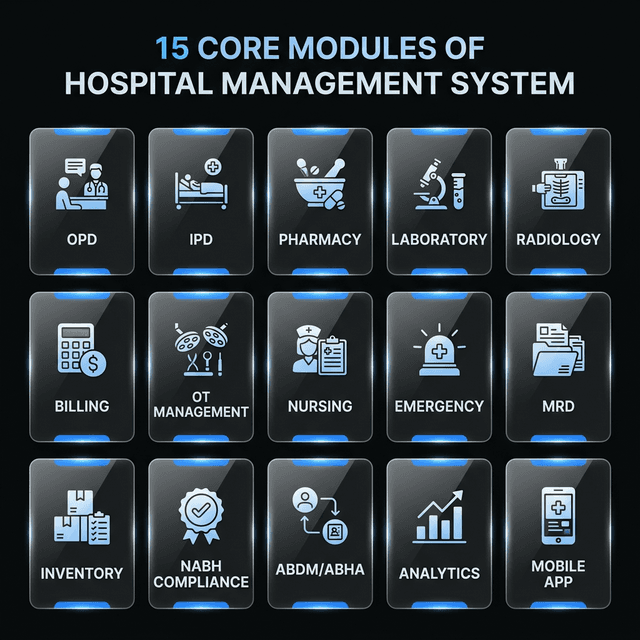
A Hospital Management System (HMS) is made up of interconnected modules, each handling a specific department or function. Choosing the right modules is critical — too few and you'll have gaps, too many and you'll pay for features you don't use. This guide breaks down all 15 standard HMS modules every hospital should know about.
What Are HMS Modules?
HMS modules are individual functional units that together form a complete hospital management system. Think of them as building blocks — each module handles a specific area (OPD, pharmacy, billing, etc.) and connects with others to create a unified system.
A comprehensive HMS should have minimum 15 integrated modules.
Integrated modules reduce data entry duplication by 70%.
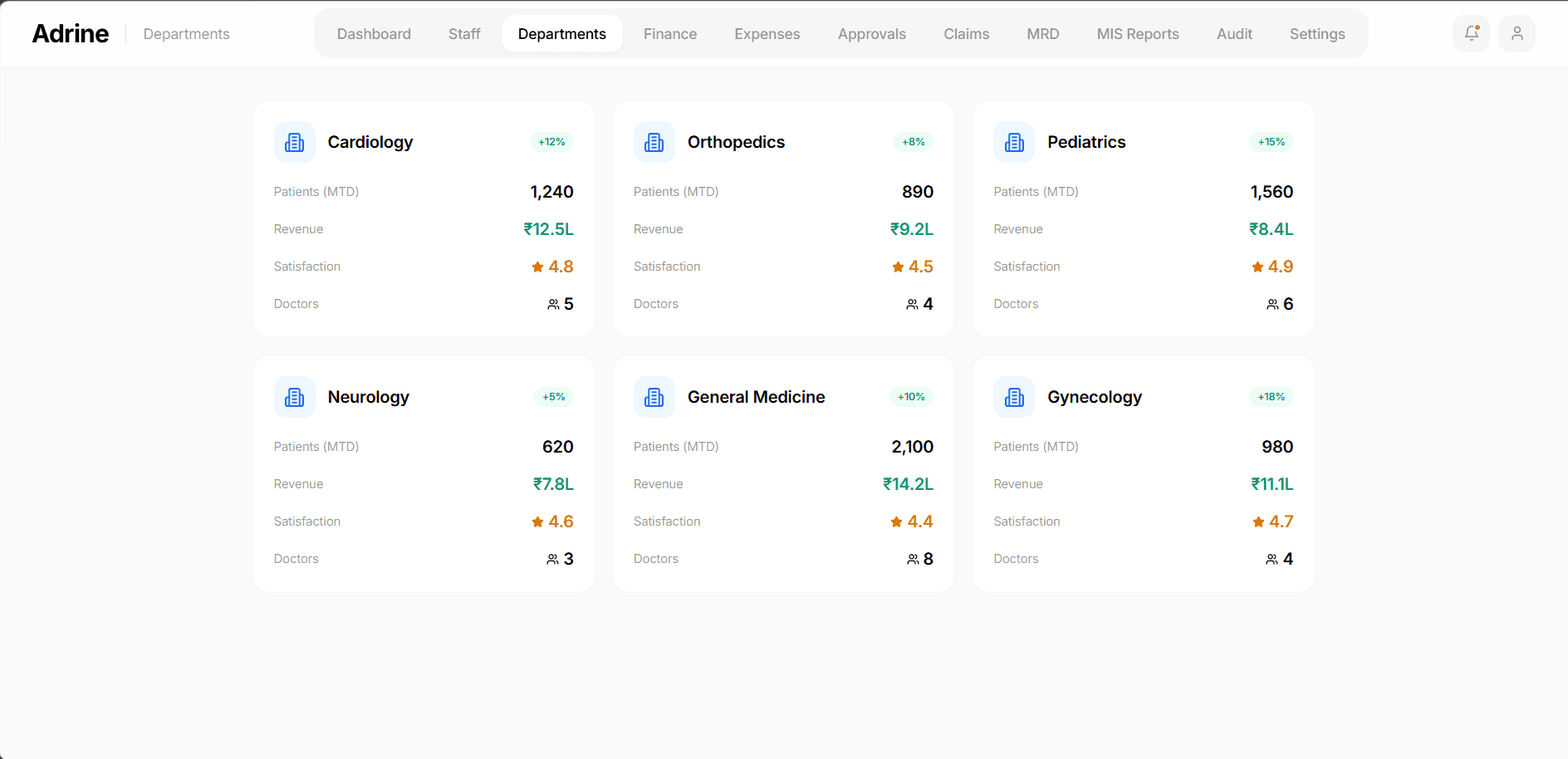
A well-integrated HMS ensures data flows seamlessly between modules. For example, when a doctor orders a blood test in the OPD module, it automatically appears in the Lab module, and the charges appear in the Billing module — all without manual entry.
The 15 Standard Modules
Module 1: OPD Management
The outpatient department module handles the highest patient volume in any hospital. It manages:
- Patient registration and UHID generation
- Appointment scheduling (online + walk-in)
- Queue management with token display
- Doctor-wise patient allocation
- Consultation notes and prescriptions
- Follow-up scheduling
Why it matters: OPD accounts for 70-80% of all hospital visits. A slow OPD means unhappy patients.
Module 2: IPD Management
The inpatient department module manages admitted patients from admission to discharge:
- Bed management and allocation
- Admission and discharge processing
- Treatment plans and progress notes
- Nursing orders and care plans
- Diet management
- Discharge summary generation
Why it matters: IPD generates 60-70% of hospital revenue. Efficient IPD = better cash flow.
Module 3: Pharmacy & Inventory
Manages your hospital's drug inventory and dispensing:
- Drug master with generic/brand mapping
- Stock management with batch tracking
- Automatic reorder alerts
- Expiry tracking and FEFO (First Expiry, First Out)
- GST-compliant billing
- Drug interaction warnings
Why it matters: Pharmacies lose ₹2-5 lakhs/year to expired drugs alone. Automation prevents this.
Module 4: Laboratory Information System (LIS)
The lab module handles diagnostic tests end-to-end:
- Test ordering from OPD/IPD
- Sample collection and tracking
- Machine interface for auto-results
- Report generation with normal ranges
- Critical value alerts
- NABL compliance documentation
Module 5: Radiology Information System (RIS)
Manages imaging department workflows:
- Modality scheduling (X-ray, CT, MRI, USG)
- DICOM worklist integration
- PACS integration for image storage
- Structured reporting with templates
- Teleradiology support
- Film/report tracking
Module 6: Billing & Revenue Cycle
The financial engine of your HMS:
- OPD/IPD/pharmacy/lab billing
- GST calculation and e-invoicing
- TPA and insurance claim management
- Package billing and discounts
- Cashless mediclaim processing
- Revenue analytics and reporting
Why it matters: Revenue leakage of 3-8% is common without automated billing.
Module 7: Operation Theatre (OT) Management
Handles surgical scheduling and documentation:
- Surgery scheduling with OT calendar
- WHO surgical safety checklist
- Anesthesia records
- Consumable and implant tracking
- Surgeon and staff allocation
- Post-op monitoring
Module 8: Nursing Station
The nurse's command center for patient care:
- Medication Administration Record (MAR)
- Vitals charting and monitoring
- Doctor order execution
- Shift handover reports
- Care plan management
- Incident reporting
Module 9: Medical Records (MRD)
Manages patient records and health information:
- Physical file tracking (for hybrid setups)
- ICD-10 coding
- Mortality and morbidity tracking
- Medico-legal case management
- Record retention policies
- Statistics and reporting
Module 10: NABH Compliance
Automates NABH accreditation preparation:
- Quality indicator tracking (all 10 chapters)
- SOP and policy management
- Internal audit scheduling
- Incident and near-miss reporting
- Patient safety goal monitoring
- Auto-generated NABH documentation
Module 11: ABDM/ABHA Integration
Connects your hospital to India's digital health ecosystem:
- ABHA ID creation and verification
- Health record sharing via consent
- HFR (Health Facility Registry) registration
- HPR (Healthcare Professionals Registry)
- FHIR-based data exchange
- M1, M2, M3 milestone compliance
Module 12: Analytics & MIS Reports
Provides data-driven insights for decision-making:
- Revenue and collection dashboards
- Bed occupancy and ALOS tracking
- Doctor-wise performance analytics
- Department-wise P&L
- Custom report builder
- Trend analysis and forecasting
Module 13: Patient Portal & Mobile App
Empowers patients with self-service:
- Online appointment booking
- Lab report and prescription downloads
- Bill payment (UPI, cards, wallets)
- Teleconsultation
- Feedback and ratings
- Health record access
Module 14: EMR (Electronic Medical Records)
The digital patient chart:
- Patient history and allergies
- Prescription with drug database
- Investigation results integration
- Clinical notes and templates
- Growth charts and scoring systems
- E-prescription with QR code
Module 15: AI & Automation
The next-generation module that's becoming standard:
- AI Voice Scribe (voice-to-prescription)
- Predictive analytics (readmission risk)
- Automated clinical decision support
- Smart billing suggestions
- Chatbot for patient queries
- Drug interaction warnings
Module Integration Map
Here's how the modules connect with each other:
| Module | Sends Data To | Receives Data From |
|---|---|---|
| OPD | Lab, Radiology, Pharmacy, Billing | EMR, Patient Portal |
| IPD | Nursing, OT, Lab, Billing | OPD (admissions), EMR |
| Pharmacy | Billing | OPD, IPD (prescriptions) |
| Lab | EMR, Patient Portal, ABDM | OPD, IPD (orders) |
| Billing | Analytics, MRD | All clinical modules |
| NABH | Analytics | All modules (quality data) |
Which Modules Does Your Hospital Need?
| Hospital Type | Essential Modules | Optional Modules |
|---|---|---|
| Small Clinic (1-5 doctors) | OPD, Pharmacy, Billing, EMR | Patient Portal |
| Nursing Home (10-30 beds) | OPD, IPD, Pharmacy, Lab, Billing, Nursing | NABH, MRD |
| Multi-specialty (50-200 beds) | All 15 modules | Dialysis, Blood Bank |
| Hospital Chain (multi-branch) | All 15 + Central Admin | Inter-branch transfer |
Frequently Asked Questions
What are the standard modules in a hospital management system?
The 15 standard modules are: OPD, IPD, Pharmacy, Lab (LIS), Radiology (RIS), Billing, OT, Nursing Station, MRD, NABH Compliance, ABDM Integration, Analytics, Patient Portal, EMR, and AI & Automation.
How many modules does Adrine HMS have?
Adrine offers 15+ integrated modules covering all hospital departments. Key differentiators include AI Voice Scribe, automated NABH documentation, and built-in ABDM/ABHA integration — all included in the base price with no per-module charges.
Can I start with a few modules and add more later?
Yes. Most modern HMS solutions like Adrine allow you to start with core modules (OPD, Billing, Pharmacy) and activate additional modules as your hospital grows. This modular approach lets you control costs while ensuring scalability.
Related Articles
- What is RIS? Radiology Information System Guide 2026
- LIS Software Guide: Best Lab Information Systems for Indian Labs
- Operation Theatre Management System: Complete OT Software Guide
- Hospital Billing Software with GST 2026: Complete Guide
- NABH 6th Edition Standards 2026: Key Changes
- ABDM FHIR Integration Guide 2026
Get All 15+ Modules in One Platform
Adrine includes all modules with no per-module pricing. See every module in action.
Book Free Demo