India's diagnostic lab market is growing at 15% annually. With increasing test volumes, NABL accreditation requirements, and ABDM integration mandates — a robust Laboratory Information System (LIS) is no longer optional. This guide covers everything you need to know about LIS in 2026.
What is a Laboratory Information System (LIS)?
A Laboratory Information System (LIS) is specialized software that manages the complete workflow of a clinical laboratory — from the moment a doctor orders a test to when the patient receives their report. It eliminates manual register entries, reduces transcription errors, and speeds up report delivery.
India processes over 2 billion lab tests annually.
Digital LIS reduces report delivery time from 24 hours to 2 hours.
Sample Tracking
Barcode-based sample management
Auto Results
Machine interface for auto capture
Smart Reports
Formatted reports with ranges
LIS vs LIMS: What's the Difference?
| Feature | LIS | LIMS |
|---|---|---|
| Full Form | Laboratory Information System | Lab Information Management System |
| Used By | Clinical/medical labs | Research/industrial labs |
| Focus | Patient diagnostics | Sample tracking, QC |
| Compliance | NABL, NABH, ABDM | ISO 17025, GLP |
| Reports | Patient reports to doctors | Batch/research reports |
| Integration | HMS, EMR, billing | ERP, quality systems |
Bottom line: If you're a hospital or diagnostic center serving patients, you need LIS. If you're a pharma/research lab, you need LIMS.
LIS Workflow: From Order to Report
Step 1: Test Order
Doctor orders a test from OPD/IPD. The order flows into LIS automatically from the HMS.
Step 2: Sample Collection
Phlebotomist collects the sample. LIS generates a barcode label ensuring zero mix-ups.
Step 3: Sample Processing
Sample reaches the lab. Technician scans the barcode to pull up the order. LIS tracks sample status in real-time.
Step 4: Result Entry/Capture
Results entered manually or auto-captured from analyzers (Beckman, Sysmex, Roche, etc.) via machine interface.
Step 5: Validation
Pathologist reviews results, checks against normal ranges, flags critical values, and validates the report.
Step 6: Report Generation
LIS generates a formatted report with hospital letterhead, normal ranges, and pathologist signature.
Step 7: Delivery
Report is shared with the referring doctor via HMS, sent to the patient via SMS/WhatsApp/portal, and stored in ABDM health records.
Key Features of Modern LIS
- Barcode Sample Tracking: Eliminates sample mix-ups and manual registers
- Machine Interface: Auto-capture results from 50+ analyzer brands (Beckman, Sysmex, Roche, Erba)
- Critical Value Alerts: Instant notifications for life-threatening results
- Multi-Format Reports: Department-wise report templates with custom layouts
- QC Module: Levey-Jennings charts, Westgard rules for internal quality control
- Reference Ranges: Age, gender, and method-specific normal ranges
- Panel Management: Group tests into panels (Lipid Profile, Liver Function, etc.)
- TAT Tracking: Monitor turnaround time from sample collection to report
- NABL Compliance: Pre-built documentation for NABL accreditation
- WhatsApp Reports: Auto-send reports to patients via WhatsApp with PDF
Benefits for Indian Labs
- 60% Faster TAT: Auto-capture + auto-validation reduces report time
- Zero Transcription Errors: Machine interface eliminates manual result entry
- NABL Ready: Built-in QC and documentation for NABL accreditation
- Higher Throughput: Process 2x more samples with same staff
- Revenue Protection: No missed billing — every test is automatically charged
- ABDM Compliant: Share lab records via ABHA framework
How to Choose LIS for Your Lab
| Lab Type | Key Requirement | Recommended |
|---|---|---|
| Hospital Lab | HMS integration, multi-department orders | Adrine (integrated LIS) |
| Standalone Diagnostic | Walk-in billing, B2B referral | Cloud LIS with portal |
| Lab Chain (multi-branch) | Central processing, satellite collection | Enterprise LIS |
| Research Lab | Sample tracking, batch management | LIMS (not LIS) |
Frequently Asked Questions
Can LIS integrate with all analyzers?
Modern LIS solutions support 50+ analyzer brands through standard interfaces (HL7, ASTM). Popular integrations include Beckman Coulter, Sysmex, Roche, Erba, Mindray, and Siemens. Adrine's LIS supports all major Indian lab analyzers.
Is LIS different from the lab module in HMS?
A lab module in HMS handles basic test ordering and result entry. A full LIS adds machine interface, barcode tracking, QC, and NABL compliance. Adrine combines both — a full-featured LIS integrated within the HMS.
Related Articles
- What is RIS? Radiology Information System Guide 2026
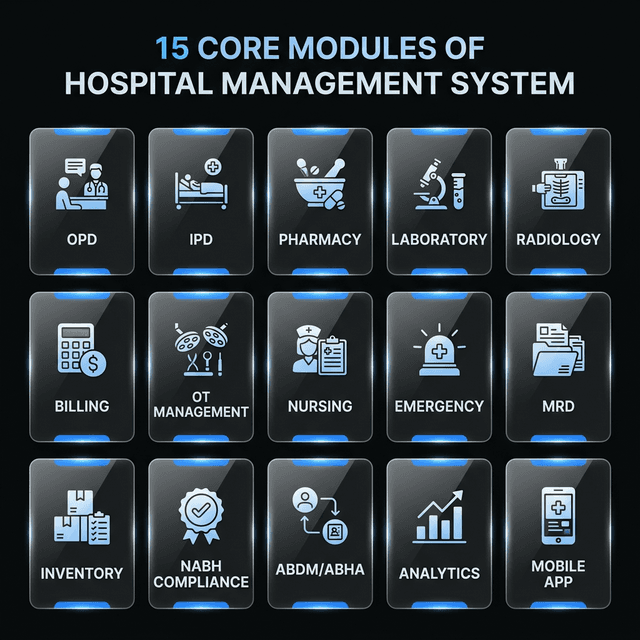
- 15 Standard Modules in Hospital Management System
- ABDM FHIR Integration Guide 2026
- ABHA Technical Integrators India 2026
See Adrine's Integrated LIS in Action
Barcode tracking, machine interface, NABL compliance — all integrated with your HMS. Zero manual entry.
Book Free Demo