A Laboratory Information System (LIS) is software that manages the complete workflow of a clinical laboratory — from sample collection and barcode tracking to test processing, result validation, and digital report delivery. Modern LIS systems reduce manual errors by 95% and increase lab throughput by 40%.
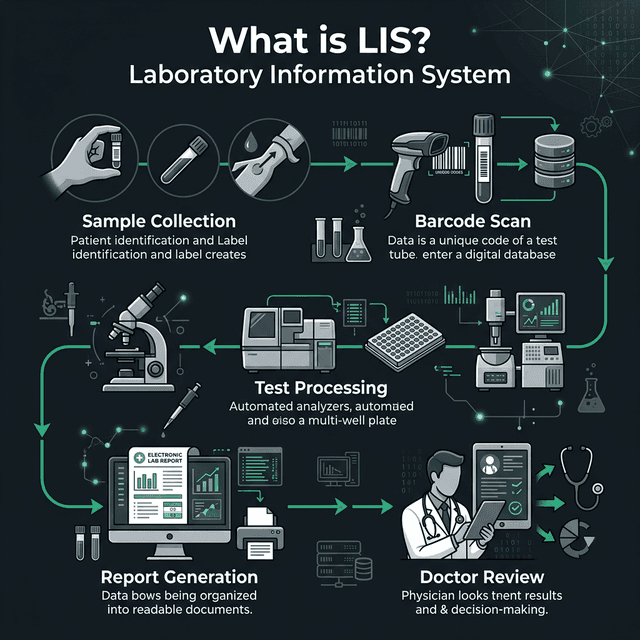
What Does LIS Stand For?
LIS stands for Laboratory Information System. It is also referred to as Laboratory Information Management System (LIMS) in some contexts, though technically LIS is specific to clinical/diagnostic labs while LIMS is used in research and industrial labs.
In a hospital setting, LIS is one of the core modules of any Hospital Management System (HMS), connecting laboratory operations with patient records, billing, and clinical decisions.
India has 1.2 lakh+ diagnostic laboratories, but only 15% use a modern LIS system. This creates enormous errors — 7.7% of lab reports have transcription mistakes in manual labs.
How LIS Works: The Complete Workflow
Test Order
Doctor orders test from EMR, auto-sent to lab
Sample Collection
Barcode label printed, linked to patient & tests
Processing
Analyzer runs test, results auto-captured via HL7
Validation
Auto-validate normal, flag critical for pathologist
Reporting
Digital report generated with reference ranges
Delivery
Report sent via SMS, WhatsApp, patient portal
Key Features of a Modern LIS
1. Barcode-Based Sample Tracking
Every sample gets a unique barcode label at collection. This eliminates patient identification errors and enables real-time sample tracking from collection point to analyzer to report.
2. Analyzer Integration (HL7/ASTM)
Modern LIS connects directly to lab analyzers using HL7 and ASTM protocols. Results flow automatically from the machine to the LIS — no manual data entry, no transcription errors.
Labs with analyzer integration process 40% more samples with the same staff compared to manual entry labs.
3. Auto-Validation Rules
Configure rules to automatically validate results within normal ranges. Only abnormal or critical values are flagged for pathologist review, reducing validation time by 60%.
4. Critical Value Alerts
When a result falls in the critical range (e.g., blood glucose < 50 mg/dL), the LIS immediately alerts the treating doctor via SMS/notification. This is a NABH requirement.
5. TAT (Turnaround Time) Monitoring
Real-time dashboards tracking time from sample receipt to report delivery for each test type. Industry benchmarks:
- Routine biochemistry: < 4 hours
- Hematology (CBC): < 2 hours
- Emergency tests: < 1 hour
- Culture sensitivity: 48-72 hours
6. Quality Control (QC) Management
Track daily QC runs with Levey-Jennings charts. Automatic Westgard rule application. This is critical for NABL accreditation.
7. Digital Report Delivery
Send reports via SMS, WhatsApp, email, or patient portal. Include QR code for verification. Link to previous results for trend analysis.
LIS vs LIMS: What's the Difference?
| Aspect | LIS | LIMS |
|---|---|---|
| Primary Use | Clinical/diagnostic labs | Research/industrial labs |
| Focus | Patient workflow | Sample lifecycle |
| Integration | HMS, EMR, billing | ERP, instruments |
| Compliance | NABL, NABH, ABDM | ISO 17025, GLP |
Benefits of LIS for Indian Hospitals
- 95% reduction in transcription errors — no manual data entry from analyzers
- 40% more throughput — process more samples with same staff
- 60% faster TAT — automated workflow eliminates bottlenecks
- NABL compliance — built-in QC tracking and audit trails
- Digital reports — WhatsApp/SMS delivery reduces patient visits
- Revenue tracking — per-test profitability analysis
Diagnostic laboratories using integrated LIS report 60% faster turnaround times and 95% fewer transcription errors.
Adrine's Laboratory Module
Adrine's LIS module is built specifically for Indian diagnostic labs and hospital laboratories:
- HL7 integration with 50+ analyzer brands
- Barcode-based sample tracking from collection to report
- Auto-validation with configurable rules
- Critical value SMS alerts to doctors
- NABL-compliant QC dashboards
- WhatsApp report delivery with QR verification
- Integrated with full HMS ecosystem
See LIS in Action — Free Demo
Watch how Adrine's laboratory module automates sample tracking, analyzer integration, and digital report delivery.
Get Free Demo