NABH accreditation is structured around 10 chapters covering approximately 100 standards. Each chapter addresses a critical aspect of hospital quality — from patient care and medication safety to infection control and information management. This guide breaks down every chapter with key requirements, standards count, and practical implementation tips.
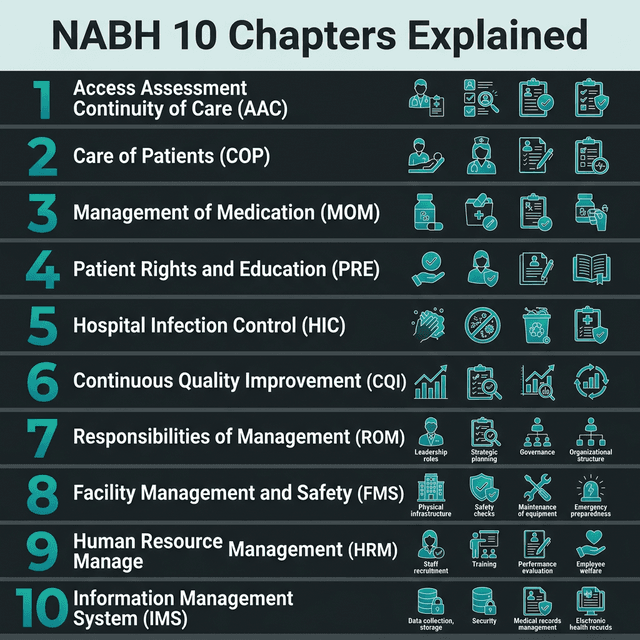
Overview: All 10 NABH Chapters at a Glance
| # | Code | Chapter Name | Standards |
|---|---|---|---|
| 1 | AAC | Access, Assessment & Continuity of Care | ~12 |
| 2 | COP | Care of Patients | ~14 |
| 3 | MOM | Management of Medication | ~8 |
| 4 | PRE | Patient Rights & Education | ~8 |
| 5 | HIC | Hospital Infection Control | ~9 |
| 6 | CQI | Continuous Quality Improvement | ~10 |
| 7 | ROM | Responsibilities of Management | ~8 |
| 8 | FMS | Facility Management & Safety | ~10 |
| 9 | HRM | Human Resource Management | ~10 |
| 10 | IMS | Information Management System | ~8 |
Hospitals that systematically address all 10 NABH chapters pass accreditation 2.5x faster than those that prepare ad-hoc.
Chapter 1: AAC — Access, Assessment & Continuity of Care
Covers patient registration, initial assessment, care planning, referral processes, and discharge. Ensures every patient gets timely access and proper assessment.
Key Areas: Registration protocols, triage procedures, discharge planning, transfer policies, continuity of care documentation
Chapter 2: COP — Care of Patients
Clinical care delivery standards including ICU protocols, surgical safety, anesthesia, blood bank, and specialty-specific care guidelines.
Key Areas: WHO surgical safety checklist, ICU protocols, blood transfusion safety, nutritional assessment, pain management
Chapter 3: MOM — Management of Medication
Medication prescribing, dispensing, administration, and monitoring. Includes high-alert medication management and adverse drug reaction reporting.
Key Areas: Drug formulary, look-alike/sound-alike drugs, high-alert medications, ADR reporting, prescription audit
Chapter 4: PRE — Patient Rights & Education
Informed consent, patient privacy, complaint management, and health education. Ensures patients know their rights and are educated about their conditions.
Key Areas: Informed consent forms, patient feedback, complaint resolution, health education materials, DAMA process
Chapter 5: HIC — Hospital Infection Control
Infection prevention and control program. Hand hygiene, biomedical waste management, sterilization, antimicrobial stewardship, and HAI surveillance.
Key Areas: Hand hygiene compliance, CSSD protocols, biomedical waste segregation, antibiotic stewardship, HAI rates
Chapter 6: CQI — Continuous Quality Improvement
Quality indicator tracking, clinical audits, sentinel events, root cause analysis, and patient safety culture. The backbone of NABH compliance.
Key Areas: Quality indicators, clinical audits, sentinel event reporting, RCA, near-miss reporting, patient safety goals
Chapter 7: ROM — Responsibilities of Management
Leadership, governance, strategic planning, and ethical practices. Hospital leadership must demonstrate commitment to quality and safety.
Key Areas: Leadership rounds, quality committee, budget allocation for safety, ethical framework, strategic plan
Chapter 8: FMS — Facility Management & Safety
Physical infrastructure, fire safety, equipment maintenance, disaster management, and environmental safety. Regular drills and audits required.
Key Areas: Fire safety drills, equipment maintenance logs, disaster plan, CCTV, electrical safety, water quality testing
Chapter 9: HRM — Human Resource Management
Staff recruitment, credentialing, training, performance appraisal, and employee health. All staff must meet competency requirements.
Key Areas: Credential verification, orientation program, 20 hrs/year training, immunization records, performance review
Chapter 10: IMS — Information Management System
Medical records management, data security, IT infrastructure, and clinical documentation. Increasingly important with ABDM integration.
Key Areas: MRD standards, data backup, patient record confidentiality, clinical coding, IT disaster recovery
How HMS Software Helps with All 10 Chapters
A modern Hospital Management System directly supports compliance across all 10 NABH chapters:
- AAC & COP: Digital registration, assessment forms, care plans, discharge summaries
- MOM: E-prescribing with drug interaction alerts, pharmacy integration
- PRE: Digital consent forms, patient feedback system
- HIC: Infection tracking dashboards, antibiotic stewardship reports
- CQI: Automated quality indicator tracking with trend analysis
- FMS: Equipment maintenance scheduling, safety audit checklists
- HRM: Staff credentialing database, training records
- IMS: Complete MRD management, data security, ABDM integration
Prepare for NABH with Adrine
Adrine's HMS covers all 10 NABH chapters with automated compliance tracking, audit-ready documentation, and quality dashboards.
Get Free Demo