NABH Quality Indicators 2026: Complete List of 30+ KPIs for Indian Hospitals
NABH-accredited hospitals must track 30+ quality indicators across patient safety, clinical outcomes, infection control, and operational efficiency. Yet 68% of hospitals preparing for NABH accreditation fail to implement proper quality indicator tracking. This guide lists every NABH quality indicator with benchmark values and practical tracking methods.
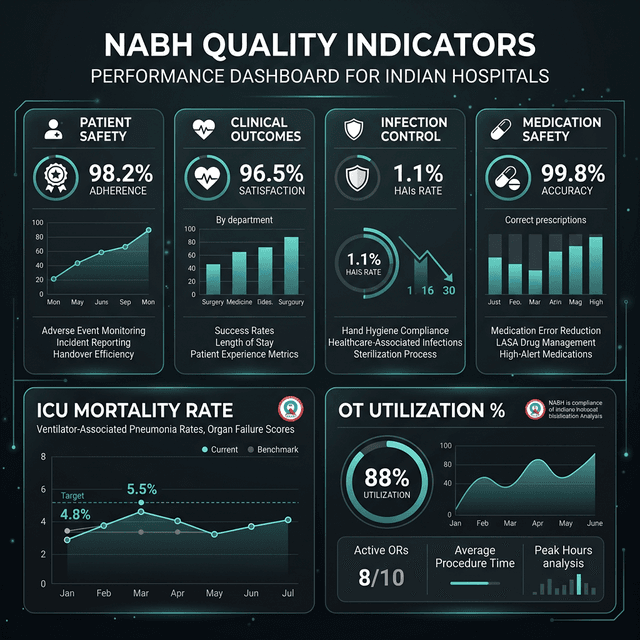
Indian hospitals that actively track NABH quality indicators see 40% fewer adverse events and 25% improvement in patient satisfaction scores within 12 months.
What Are NABH Quality Indicators?
NABH quality indicators are standardized, measurable metrics that hospitals must monitor to demonstrate continuous improvement in care quality. They are mandated under the Continuous Quality Improvement (CQI) chapter — one of the 10 chapters of NABH.
Unlike static documentation requirements, quality indicators require ongoing data collection, monthly trend analysis, and corrective action plans when benchmarks aren't met.
💡 Key Insight: NABH assessors don't just check IF you track indicators — they look for improvement trends over 6-12 months. Start tracking at least 6 months before your assessment date.
1. Patient Safety Indicators
Patient safety is the foundation of NABH accreditation. These indicators are reviewed in every assessment:
| Indicator | Formula | Benchmark |
|---|---|---|
| Patient Fall Rate | Falls / 1000 patient days | < 3.0 |
| Medication Error Rate | Errors / Total prescriptions × 100 | < 0.5% |
| Patient Identification Errors | ID errors / Total admissions × 100 | 0% |
| Pressure Ulcer Rate | New ulcers / Patients at risk × 100 | < 2% |
| Needle Stick Injury Rate | Injuries / 1000 patient days | < 1.0 |
2. Clinical Outcome Indicators
These measure the effectiveness of clinical care and treatment protocols:
ICU Mortality Rate
Benchmark: < 20% for general ICU. Track monthly with case-mix adjustment.
Re-admission Rate (within 30 days)
Benchmark: < 5%. Track by diagnosis category. High rates signal gaps in discharge planning.
Unplanned Return to OT
Benchmark: < 2%. Indicates surgical complications or inadequate initial procedures.
Blood Transfusion Reaction Rate
Benchmark: < 0.5%. Every reaction must be documented and investigated.
Hospitals using automated quality tracking systems report 3x faster data collection and 90% reduction in manual reporting errors during NABH assessments.
3. Infection Control Indicators
Infection control (covered under NABH Chapter 5: HIC) requires meticulous tracking:
| Indicator | Frequency | Benchmark |
|---|---|---|
| Surgical Site Infection (SSI) Rate | Monthly | < 3% |
| Catheter-Associated UTI (CAUTI) | Monthly | < 5 per 1000 catheter days |
| Central Line Blood Stream Infection (CLABSI) | Monthly | < 3 per 1000 line days |
| Ventilator-Associated Pneumonia (VAP) | Monthly | < 5 per 1000 ventilator days |
| Hand Hygiene Compliance Rate | Weekly audit | > 80% |
4. Medication Safety Indicators
- Adverse Drug Reaction (ADR) Reporting Rate: Minimum 1 ADR report per 100 admissions. Under-reporting is a common NABH audit finding.
- High-Alert Medication Error Rate: Track errors with look-alike/sound-alike drugs. Benchmark: Zero tolerance.
- Antibiotic Sensitivity Compliance: % of antibiotics prescribed after culture sensitivity. Benchmark: > 70%.
- Drug Expiry in Patient Care Areas: Benchmark: 0 expired drugs found. Monthly checks required.
5. OT & ICU Indicators
These operational indicators are critically reviewed during NABH assessments:
OT Utilization
> 70%
OT Cancellation
< 5%
WHO Checklist
100%
ICU Bed Occupancy
75-85%
6. Patient Experience Indicators
- Patient Satisfaction Score: Benchmark: > 80%. Must be measured through structured feedback forms.
- Average Length of Stay (ALOS): Track by diagnosis. Compare against national averages.
- Discharge Against Medical Advice (DAMA) Rate: Benchmark: < 5%. High rates indicate care quality or communication issues.
- Patient Complaint Resolution Time: Benchmark: < 48 hours for non-critical, < 24 hours for critical complaints.
7. Operational Efficiency Indicators
- Bed Occupancy Rate: Benchmark: 70-85%. Below 60% = underutilized, above 90% = overcrowded.
- Average Revenue Per Occupied Bed (ARPOB): Track monthly for financial sustainability.
- Employee Turnover Rate: Benchmark: < 15% annually. High turnover affects care continuity.
- Training Hours Per Employee: NABH mandates minimum 20 hours/year of continuing education.
How to Track NABH Quality Indicators Effectively
Manual vs Automated Tracking
| Aspect | Manual (Excel) | Automated (HMS) |
|---|---|---|
| Data Collection Time | 40+ hours/month | Automatic |
| Error Rate | 15-20% | < 1% |
| Trend Analysis | Manual charts | Real-time dashboards |
| Assessment Readiness | 2 weeks prep | Always ready |
Hospitals using automated HMS quality tracking pass NABH assessments 2.5x faster than those relying on manual Excel-based tracking.
Adrine's NABH Quality Dashboard
Adrine's Hospital Management System automatically captures all 30+ NABH quality indicators from daily hospital operations:
- Real-time dashboards with color-coded benchmark alerts
- Automatic trend charts — 6, 12, 24-month views for assessment
- Incident reporting integrated with quality tracking
- One-click NABH reports — generate assessment-ready documentation
- Department-wise breakdowns for targeted improvement
Track All 30+ NABH Quality Indicators Automatically
See how Adrine's NABH Quality Dashboard automates indicator tracking and generates assessment-ready reports.
Get Free Demo