One of the first decisions when choosing hospital management software is deployment: Cloud or On-Premise? Each has distinct advantages. This guide helps you make the right choice for your hospital's specific needs.
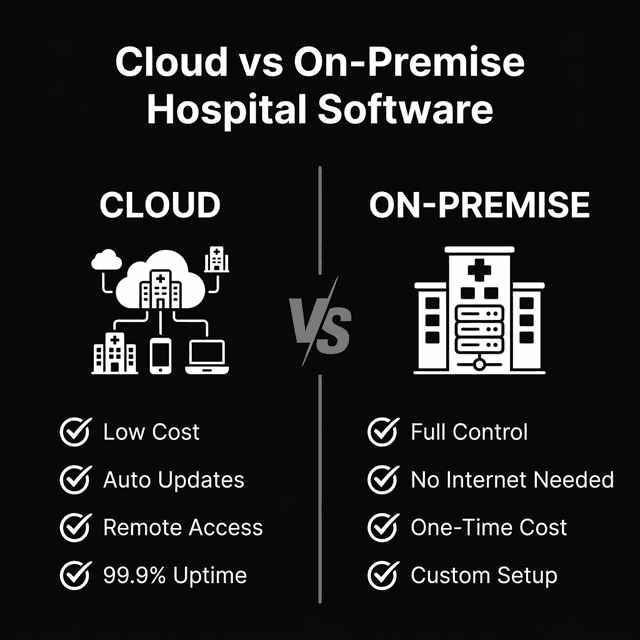
Quick Comparison
| Factor | ☁️ Cloud | 🖥️ On-Premise |
|---|---|---|
| Upfront Cost | Low (₹0-1L) | High (₹5-20L) |
| Monthly Cost | ₹10K-2L/month | AMC only |
| Setup Time | 1-2 weeks | 1-3 months |
| IT Staff Needed | Minimal | Dedicated team |
| Remote Access | Built-in | VPN required |
| Updates | Automatic | Manual |
| Data Control | Vendor managed | Full control |
| Internet Dependency | Required | Optional |
What is Cloud Hospital Software?
Cloud-based (or SaaS) hospital software runs on the vendor's servers and is accessed via internet browser. Think Gmail or Google Docs—you don't install anything, just log in from anywhere.
67% of Indian hospitals now prefer cloud-based HMS.
Cloud HMS reduces IT infrastructure costs by 40%.
On-premise solutions require 3-5x higher upfront investment.
Examples: Adrine (Cloud-first), Practo, HealthPlix
Advantages of Cloud
- Low Entry Cost: No server purchase needed
- Quick Setup: Go live in 1-2 weeks
- Access Anywhere: Work from hospital, home, or mobile
- Automatic Updates: Always on latest version
- Automatic Backups: Data protected by vendor
- Scalable: Add beds/users without hardware changes
Disadvantages of Cloud
- Internet Dependency: Outage = no access (unless offline mode)
- Ongoing Costs: Monthly fees add up over years
- Data Location: Less control over where data is stored
- Customization: May be limited compared to on-premise
What is On-Premise Hospital Software?
On-premise software is installed on your hospital's own servers. You own the hardware and the software license. All data stays within your building.
Examples: Marg ERP, traditional legacy systems
Advantages of On-Premise
- Full Data Control: Data never leaves your premises
- No Internet Required: Works offline completely
- One-Time License: Can be cheaper long-term for large hospitals
- Deep Customization: Modify anything with source code access
- Regulatory Comfort: Some feel safer with local data
Disadvantages of On-Premise
- High Upfront Cost: Servers, licenses, installation
- IT Overhead: Need dedicated IT staff for maintenance
- Manual Updates: You're responsible for upgrades
- Disaster Risk: Fire/flood could destroy data (unless offsite backup)
- Limited Remote Access: VPN setup required
Who Should Choose Cloud?
- Small to medium hospitals (under 200 beds)
- Clinics and polyclinics
- Hospitals without dedicated IT teams
- Multi-location hospital chains
- Startups wanting quick go-live
- Hospitals prioritizing telemedicine
Who Should Choose On-Premise?
- Very large hospitals (500+ beds) with IT teams
- Government hospitals with strict data policies
- Areas with unreliable internet connectivity
- Hospitals requiring deep customization
- Organizations with 10+ year planning horizon
The Hybrid Approach
Many modern solutions, including Adrine, offer hybrid deployment:
- Cloud-first with offline capability: Works even when internet is down
- Local cache + cloud sync: Fast performance with cloud backup
- Best of both worlds: Remote access + data security
2026 Trend: Cloud is Winning
Over 70% of new hospital software implementations in India are cloud-based. Reasons:
- Internet connectivity has improved dramatically
- ABDM/ABHA requires cloud integration anyway
- Telemedicine needs cloud access
- Multi-branch hospitals need centralized data
Want the Best of Both Worlds?
Adrine offers cloud convenience with offline reliability. See it in action.
Get Free Demo